
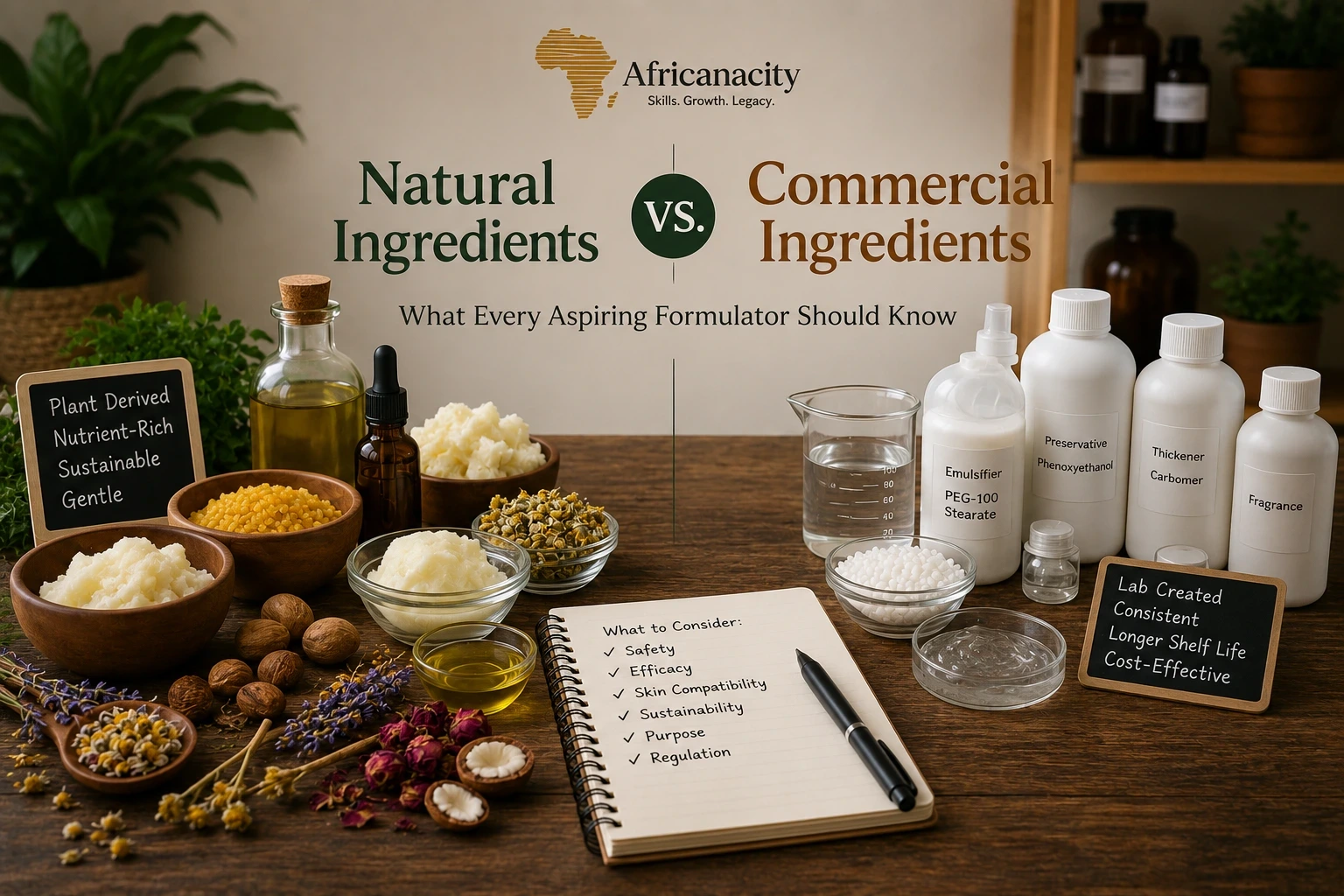
"Natural" sells. Walk through any market or scroll through social media, and you'll see it everywhere — natural soap, natural skincare, natural remedies. But for aspiring formulators, the natural-versus-commercial ingredient decision is more nuanced than marketing makes it seem. Here's what you actually need to know before choosing your ingredients.
"Natural" Doesn't Automatically Mean Safer or Better
It's a common assumption: natural ingredients are gentler and safer, while commercial or synthetic ingredients are harsh or harmful. In reality, safety depends on the specific ingredient, concentration, and how it's used — not simply whether it's labeled "natural."
Some natural ingredients can cause allergic reactions or skin irritation (certain essential oils, for example), while many synthetic ingredients are specifically engineered for stability, safety, and effectiveness. The goal isn't to pick a side — it's to understand what each ingredient actually does.
The Real Strengths of Natural Ingredients
Natural ingredients genuinely offer benefits that make them a strong choice for many products:
- Consumer appeal — many customers actively seek out natural formulations
- Fewer synthetic additives — appealing to customers avoiding certain chemicals
- Rich nutrient and beneficial compound content — many natural oils and butters offer genuine skin benefits
The trade-off: natural ingredients often have shorter shelf lives, more batch-to-batch variability, and can be more expensive or harder to source consistently.
The Real Strengths of Commercial/Synthetic Ingredients
Commercial ingredients, often unfairly seen as "inferior," offer their own genuine advantages:
- Consistency — the same ingredient performs the same way, batch after batch
- Stability and shelf life — many synthetic preservatives and stabilizers significantly extend product life
- Precision — formulated for specific outcomes (texture, absorption, effectiveness)
The trade-off: some customers actively avoid synthetic ingredients, and certain synthetic additives do carry more caution around specific health or environmental concerns, depending on the ingredient.
Preservatives: Where This Debate Matters Most
This is one of the most important — and most misunderstood — parts of formulation. Many "all-natural, preservative-free" products sound appealing, but products containing water (creams, lotions) are highly vulnerable to bacterial and mold growth without proper preservation.
An unpreserved or poorly preserved product isn't more "pure" — it's often unsafe, especially with repeated use over time. Learning safe, appropriate preservation methods, whether natural or synthetic, is one of the most critical formulation skills to develop.
How to Decide What's Right for Your Products
Instead of picking "natural" or "commercial" as an identity for your brand, evaluate ingredient choices product by product:
- What does this specific ingredient need to do (moisturize, stabilize, preserve, fragrance)?
- Is there a natural option that performs this function reliably and safely?
- Does my target customer have a strong preference, and can I meet it without compromising safety or shelf life?
- Am I formulating this correctly regardless of ingredient source?
Some of the best-performing, most successful products use a thoughtful blend of both — natural ingredients for their genuine benefits, and select commercial ingredients (especially preservatives) for safety and stability.
Educate Your Customers, Don't Just Market to Them
If "natural" is part of your brand identity, be specific and honest about what that means for your products — which ingredients are natural, why you chose them, and how you ensure safety and shelf stability. Customers increasingly value transparency over buzzwords, and it builds far more trust than a vague "100% natural" label.
Good Formulation Is About Function, Not Fashion
The natural-versus-commercial debate often gets treated as a moral choice, but for a formulator, it's really a functional one: what does this product need to be safe, effective, and stable? Understanding both ingredient categories deeply — not favoring one blindly — is what separates hobbyist formulation from professional-quality products.
My Skill-Up Hub's cosmetic formulation courses teach the science behind ingredient choices, so you can formulate with confidence, not guesswork — whatever ingredients you choose to work with.